

Soft-Coated Wheaten Terrier Club of GB

  • Increase font size
  • Default font size
  • Decrease font size
Home Owning a Wheaten Owning a Wheaten

Owning a Wheaten

E-mail Print PDF
The positive side of sharing your home and life with a dog will depend largely upon your attitude. If you treat a dog firmly, but with kindness and respect, he will give you a lifetime of devotion. He will introduce you to many new friends as you go on your walks together. He will make getting up in the morning bearable because of the greeting he gives you and you will never come home to an empty house. Even grooming him can be therapeutic at the end of a tiresome day. The love and companionship of a well trained dog is priceless.

However, having a dog is a lot of extra work and responsibility. It isn't easy. You must be prepared to put time and effort into training from the day you get  him. Whenever someone comes to the house he will bark, and, if you have a Wheaten, engage in lots of loony leaps and other antics - not all visitors will like it. Whatever the weather, no matter how tired you feel, you must take him for walks at least twice a day and be able to turn a blind eye to the dirt he brings in. The doors and walls will get dirty at dog level where he rubs against them and he will need regular grooming.

Remember you can't do things on impulse which don't include the dog, such as staying overnight with friends after a dinner party because you've had one over the odds to drink. Also, unless you can overcome feelings of guilt and put him in kennels; an additional expense, you must get used to holidays within the UK so that he can go with you.

Vet's fees can be a nightmare although insurance schemes are available and, as you are taking on a responsibility which will last anything between 10 and 15 years, you need to be prepared for both the emotional and financial commitment.

To discover more about the breed, read on. You can jump to specific topics by clicking on the links below: 

Is a Soft-Coated Wheaten Terrier For You?
Helpful Hints
The Wheaten Coat. Irish or English?
Dog or Bitch
Training
Grooming
So, You Still Want a Wheaten Puppy?
Conclusion


Is a Soft-Coated Wheaten Terrier For You?

Before deciding on a Soft-Coated Wheaten Terrier, you must be absolutely certain that this is the right breed for you and your family. If he isn't and you buy one, you will all be thoroughly unhappy. It is strongly recommended that you visit one of the Club's Area Representatives. These are experienced Wheaten owners who you can talk to about  the pluses and minuses of Wheaten ownership and meet their dog in a home environment. In fact, many breeders will not consider you for a puppy unless you have done so.

The Soft-Coated Wheaten Terrier is a handsome, medium sized dog whose coat does not shed. He is a fun loving dog, both intelligent and loyal. He is generally a good watchdog. He likes people and mixes with children. He mostly gets along with other dogs. Although a country dog, he is adaptable to city life. But, all of this does not make him everybody's ideal pet.

If you are looking for a dog that will respond instantly to your every command, then maybe a terrier isn't for you. Terriers do have minds of their own! If you want a dog that develops strong owner loyalty, maybe a Wheaten isn't for you. This breed tends to be an 'everybody dog', relating well to the family but also enjoying making new acquaintances. If you prefer a dog that lies quietly in his basket waiting to be invited to do something, then perhaps a Wheaten isn't the dog for you. Wheatens are far more likely to do the inviting!

No one should consider having a Wheaten unless they have the time and patience to work intensively with a young puppy from the day they bring him home. Training must start straight away and for the first twenty-four months daily grooming sessions are necessary to maintain his handsome appearance and to keep his beautiful coat in shining, matt free condition. This is essential to get him used to grooming and being handled. Once the coat has matured to the full adult coat at about 2 years of age, a thrice-weekly session is sufficient.

Helpful Hints

First there is the vital question of obedience. When out for a walk, your dog may rush off on a frolic of his own, even though he can hear your cry of "Biscuit! Don't panic as he disappears over the horizon, just shout 'Telly' instead. This will bring him back instantly, on the assumption that you have brought a portable T.V. and it's time for "One Man and His Dog" or "The Horse of the Year Show".

Then there is the question of visitors to the house.

Most will never get through the door, but if your mother-in-law forces her way in, try to avoid her settling in his favourite chair as he may then decide to sit on her head. In this event, a sharp cry of "pussy cat" will result in vertical take-off, causing only superficial injuries, and without dislodging her hat.

Try to avoid him making friends with the Milkman, and introduce him to the Postman instead. Shredded paper is both quieter and safer than broken glass.

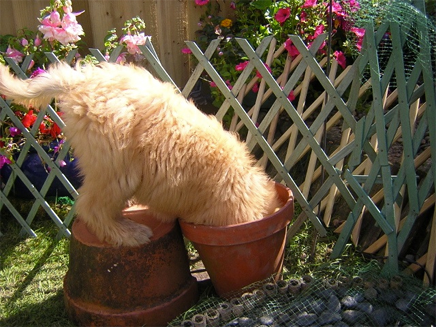
Your dog will love helping you in the garden, especially with the weeding. He either lies beside you, hiding the next weed and at the same time systematically emptying the bucket you are filling, or checks up after you, digging up any flowers which you have carefully preserved.

My advice is not to do any gardening at all. A Wheaten will follow you to the ends of the earth, especially around the house, and when you come downstairs, will try to be both behind and in front of you at the same time. To avoid being tripped, start slowly and accelerate rapidly towards the end like Sebastian Coe.

People have asked what characteristic most distinguishes the Wheaten from other breeds. The answer is that it is the only canine floor polisher. Approach your Wheaten when he is resting in a remote corner, and invite him to retire for the night. He will roll onto his back and convert himself into a floppy, shapeless mass. In this state he cannot be lifted, but can be slid from one part of the house to another, thus producing gleaming woodwork. This is why he is known as the "Old Buffer". With a Wheaten in the house, you need never again fear the knock of the Kleeneze man.

Wheatens enjoy good food, especially if it is yours rather than theirs. If your dog accidentally eats an entire Camembert, open all the windows for a day or two, or better still, send him to your Mother-in-law for the duration, but above all avoid naked lights!

One final tip - don't waste your time trying to photograph him. By the time you've adjusted the focus for distance, the only thing in the picture will be a big black nose.

Inevitably there are some aspects of life with a Wheaten for which no helpful hints can be offered. Maybe yours too is a household in which there is no handle on any of the shopping baskets, all plastic containers have been turned into sieves, the wastepaper bins are kept on top of the furniture, the garden is full of brushes and brooms and the house full of branches and twigs, and no one can ever find a pair of matching socks.

But never mind, remember it's all worthwhile for the sheer fun of being owned by a beautiful, mischievous Wheaten!

The Wheaten Coat 'Irish or 'English'?

Over the years, two distinguishable coat types have evolved in the Soft-Coated Wheaten Terrier: the 'Irish' coat and the heavier coat, which is frequently referred to as the 'English' coat. You may also hear people mention 'American' coat. This is another heavy coat, often denser still.

The original 'Irish' coat (Ireland being the country of origin) is a soft, silky coat, which on the adult Wheaten, falls in waves of soft curls closely following the contours of the body. The hairs are fine and have a high sheen or gloss. In England and the USA, a heavier coat has developed, usually referred to as the 'English' coat. The adult coat again should have soft waves or curls but is much thicker and heavier, giving the dog a heavier overall appearance. It rarely has the Irish coat's sparkle.

The coat on an 'Irish' puppy is sparse and can be either fluffy or quite coarse in texture, giving the puppy a ragamuffin appearance. The puppies often have black ears and sometimes black masks as well, which grow out as the dog matures. The 'Irish' coat can take three or more years to mature to its full silky splendour. The leg coat in particular takes time to develop in the immature dog. The heavy coated puppy has a more abundant coat and gives the appearance of a cuddly bear. The pups have black ears, masks and occasionally markings. Any black on the body should have grown out by two years of age but some grey is usually retained on the ears and muzzle. The English pup is quicker to gain a mature looking coat, although the final coat may take as long to achieve as the Irish type.

The majority of puppies bred in England are of the heavier coat type. Whilst a few breed pure Irish lines, in some cases they are being interbred resulting in both types in the same litter. The breeder will be aware if there is a possibility of a 'mixed' litter from the pedigrees of the parents. It should be remembered that the pure Irish gene is dominant over the 'heavy coat' recessive gene. Interbreeding does not produce a "midway" or "in-between" coat. Some Irish coats are sparser than others and similarly some of the heavier ones are denser than others but the adults can usually be identified as one type or the other.

To avoid disappointment in the future, it is advisable if possible to see adult Wheatens of both types before buying a puppy. Most dog books only feature the heavier coats but the Club's Breed Handbook (and the video) have photographs of both types. Ask to see these if you visit an Area Representative or one of the SCWT Club events.

Dog or Bitch?

Many books advise that a bitch is an easier companion than a dog and whilst this may be true of some breeds, it is not necessarily the case with Wheatens. Whichever sex you choose with this breed you should remember that you are getting a terrier and you will get terrier characteristics to a greater or lesser extent. For example, some Wheatens will be prodigious cat chasers whilst others will yawn at the very idea of such exertion! With Wheatens it really does seem to depend on the individual animal, rather than its sex, as to how it responds to its family and other dogs. Some bitches can appear quite bossy and uppity compared to a more passive male.

The male Wheaten can be as loving and affectionate a companion to his owners as a bitch. Both can be very lively. Some people would never choose to have a bitch having once owned a male Wheaten, because they feel that the dog has more character.

Adolescent males (9 to 18 months) often become more aware of other male dogs and can see them as a challenge. Careful handling is required to see them through this stage as with any teenager. It is here that the benefits of training classes and extensive socialisation can be seen. Male dogs in general require more 'doggy knowledge' to train and are perhaps not always suitable for a first time dog owner.

Either sex, being a terrier, need firm handling from puppy hood - you should never assume, if you get a bitch, that she will be less wilful than her male counterpart. This is just not the case in this breed. It will depend to what degree the individual animal has a capacity for dominance - a dominant bitch may be hell to live with - a submissive dog will be a joy by comparison and vice versa.

You need to bear in mind your family and its requirements and capabilities when choosing the sex of your dog. The neutered animal of either sex is possibly easier to live with if you have very young children. (Do take advice from your breeder or the Club, before neutering as this is often done at too young an age.) For sure you will encounter difficulties with the in-season bitch if your children appear to suffer congenital inability to close doors and gates (as many do!), as, at the critical time of her season, the bitch my be anxious to be mated and may attempt to escape to achieve her objective.

Her seasons will happen, on average, every six months, irrespective of Christmas, annual holidays, family weddings, etc. You may also, depending on the location of your home, undergo a siege by the local roaming males - some of whom may camp out on your doorstep, contriving to get to your bitch by fair means or foul! Needless to say, none of these problems occur with the male.

Some general books on dogs suggest that the male will wander - well so may the female if she gets half the chance. The answer is that you train your dog, from the day you get it, that it goes out only on its lead with you until you reach a place where it can safely run off lead. Wheatens are great would-be Houdini's so you need a well-fenced garden for either sex.

Choosing whether to have a dog or bitch does, at the end of the day, come down to personal circumstances and preferences. If you are buying your Wheaten as a family pet, the sex of the dog doesn't matter one iota. As previously stated, with Wheatens the difference is usually down to the individual animal's temperament and not its sex. Both the dog and the bitch in this breed are wonderful loving companions.
 

Training

The Wheaten needs careful rearing and socialisation. He can be extremely wilful and stubborn. Therefore gentle, but firm and consistent, training is essential. As with other breeds, the Soft-Coated Wheaten Terrier reflects the care and training he has received. Optimum temperament can only be achieved through gentle, regular human contact.

The Wheaten is a lively, quick witted dog and consequently, quick to learn but he has his share of terrier's independence and can sometimes be obstinate. However, he is anxious to please his owner and can readily be trained to a high standard if the appropriate methods are used. If a command is given, is it essential that the owner insists that it is obeyed. Should a Wheaten gain the idea that its okay to do a thing sometimes and other times not, problems could be ahead.

As the dog is a pack animal by nature, he will defer to the pack leader who MUST be you. He must never gain the impression that he's in with a chance of usurping that position, although with a dominant dog, this may not stop him trying.

Obeying the basic commands of 'sit', 'down', 'stay', 'come' and 'give' could prevent serious injury to your dog and even save his life in some situations. It will also make him a more enjoyable companion to be with.

The necessity for immediate, early socialisation, with people, other dogs and even with other animals cannot be stressed often enough. Puppy classes, obedience classes, taking the dog everywhere you go, all contribute to a well balanced, well adjusted pet that is a delight to own. The dog who does not meet all and sundry at a young age may well react with fear (and/or aggression) to new situations.

Grooming

The Wheaten Terrier is eye-catching because of his soft, flowing coat, which gently waves, and shimmers in the sunlight. A well cared for coat is stunning. Conversely, without regular grooming, the coat becomes dull and matted and even smelly and skin problems can develop. The dog will be miserable to be in such a state and he won't begin to resemble the beautiful fellow with whom you fell in love at first sight.

To keep the coat in good, healthy condition, you must begin by grooming your puppy daily. He won't like it at first and you will hardly think it necessary but by the time he's seven or eight months of age, you'll be glad you persevered and that he doesn't mind being combed. At this time the puppy coat begins to give way to the adult coat and it is the most difficult period as far as grooming is concerned.

Dog hair that does not shed onto the carpet and your clothes sounds too good to be true - and indeed there is a catch; it must be regularly combed out. If you leave the dog without grooming for only a week, the tangles will have begun forming and the session will be uncomfortable and even painful, for him and difficult for you also. (Unless you happen to enjoy participating in all-in wrestling!)

The other drawback of a long, non-shedding coat is the amount of dirt that collects on the feet, legs and undercarriage when out walking and which is trailed back into the house. A non-shedding coat does not mean less housework and it does mean increased grooming.

The Wheaten is not a trimmed terrier - he should always appear natural. However, for his comfort, certain areas are tidied up. Details on how, and where, to do this are to be found in the Breed Handbook and in the Club's video "The Soft-Coated Wheaten Terrier. A Guide to the Care of Your Dog". Both are available from the Club Secretary or on sale at Club events.

So, You Still Want A Wheaten Puppy?

If you enjoy a lively, fun dog and you are willing to devote time and energy to grooming and training, then the Soft-Coated Wheaten could well be the dog for you.

The Club runs a puppy waiting list, details of which can be obtained by sending us your details on this form.

Because not many Wheatens are bred in the UK, it is probable that you will have to wait a few months before a puppy is available. It is rare to find a puppy immediately available. If you do so, it could be advisable to ask yourself the question "Why?" The price of a puppy is currently approximately £800 - £850, though some breeders with top winning dogs may charge more. If the price quoted for a pup sounds unreasonable, you could refer back to the puppy list co-ordinator or the Club Secretary but the amount you pay is a decision for you and the breeder. If you feel the price is too high, other puppies will be available if you are prepared to wait a bit longer.

Remember there is no substitute for a good relationship with a reliable breeder. When you are finally offered a puppy, be honest with the breeder about your circumstances - make sure that he/she knows about your home and living situation and be frank about any worries you might have. A good breeder will ask you many questions - some of which may seem irrelevant to you. This is because they want to be sure that you can provide a proper home for one of their carefully reared pups. Once you have made your circumstances clear, trust the breeder to select the best puppy for you.

Most Wheaten breeders will be actively engaged in showing their dogs. If you want a show dog, it is essential that you obtain a pup from such a person, although he/she will also be able to sell you the ideal pet. If you intend showing, make sure the breeder is aware of this fact. Maintain contact with your breeder, who will be delighted to have news and photographs of the pup occasionally, right through its adult life.

Once you take your puppy home, help him to settle in - don't overtire him during the first few days. Everything is strange to him now, away from his mum and brothers and sisters. If you have children make sure that they understand that this is a living animal with feelings and not a toy: they should be taught to respect the dog. Don't let them wake him when he is sleeping, or constantly handle him when he is awake. If your children are young and boisterous, engaging in much running and shrieking, remember that such activity can be confusing to any dog and may arouse overly protective instincts. It is unwise to leave young children of any age unsupervised with a puppy or adult dog, for both their sakes.

You should be aware that problems could occur if two unrelated Wheatens of the same sex are kept together in the same household, although it has been successfully done. Two males or two females, unless they are mother and daughter, do not always live together amicably. It is definitely not recommended to get two pups at the same time. Two puppies together are almost impossible to train, resulting in two hooligans and quite possibly two dogs that are constantly vying for the 'top dog' spot. As a first-time Wheaten owner you will have enough to cope with, learning to deal with just one puppy coat!

You should bear in mind that the neutered pet of either gender is possibly easier to live with. It is a myth that every bitch needs at least one litter - she does not. And, unless you intend your dog to be a regular stud, it is not wise to allow him to be mated to the pet bitch that lives locally. (Unless you regularly show your dog and he is a good example of the breed, it is unlikely that he will have the chance of being a regular stud anyway.)

The SCWTC of GB strongly recommends that you make your initial enquiry through the club. The club does not endorse the purchase or sale of puppies through newspaper or internet advertisements or pet shops and it recommends that you do not acquire your puppy through any of these routes. To contact us with enquiries about puppies or rehoming, please click the following link and send us your name, address, telephone number and email address, along with any queries you may have: Puppy LIst and Rehoming Enquiries

Wherever you source your puppy from ensure that it and its parents have had health tests as recommended by the Club and that they are registered with the Kennel Club. You should ask for copies of the relevant certificates from the breeder - a good breeder will be more than happy to provide these for you. It is advisable that you see the puppy with its dam and that you are happy with the conditions in which it has been raised. For reasons to be careful see our Forum.

Conclusion

In a suitable home, where discipline is gentle and consistent and where the dog know his place, where he is well loved and treated as an important member of the family, the Soft-Coated Wheaten Terrier is a delightful companion who will give you a lifetime of devotion.


Newsflash

The AGM of the SCWT Club of GB took place on Sunday 16th May, where it was announced that Mrs. Judy Creswick is to be our new President.

Mrs. Margaret House retired after 12 years as Club President and she was thanked for her devotion and committment to the Club and the breed.  Judy joined the committee in 1980 and has been Secretary since1987.

The committee for the Club for 2010 is as follows:
President:  Mrs Judy Creswick
Chairman:  Mrs Jane Charleton
Secretary:  Mrs Judy Creswick
Treasurer:  Mrs Denise Bott
Committee:
Mr John Allen                                                                                Dr Phillippa Noble
Mrs Gill Ford                                                                                  Mrs Cheryl Satherley
Mr Ian Frank                                                                                  Mrs Chris Tilley
Mrs Julie Herbert                                                                           Mrs Lynn Wassall
Mr Greg Lawrence